I've talked here before about Elden Hale, one of the driving forces who made WNEP-TV in the Wilkes-Barre/Scranton market such a dominant station—and certainly the man behind Newswatch 16's phenomenal growth and success.
I'm not sure I told you that Elden and I go back almost forty years. He and I had our first "real" TV jobs together, at the old WOOD-TV in Grand Rapids, Michigan, working for the legendary Dick Cheverton. I guess you could say we knelt at the feet of the master. I guess, if we were racehorses, you'd say we share the same bloodlines. (OK, fill in your own “horse’s asses” joke here.)
Why, then, is he so much smarter than I am?
I guess we were friendly competitors when we started out, each building a career, looking for the next big step. I was around for the birth of his children--one now in TV, the other a lawyer. But he beat me in the race for the first news director's job. He landed at WNEP. And he invited me to come see him. It was late in 1974, I think. I didn't know it, but he wanted to offer me a job.
When I got to Avoca (where WNEP was located) I found the worst TV station in America!
WBRE was Wilkes-Barre's station. WDAU (now WYOU) was Scranton's station. WNEP, at the airport, was nobody's station, and it showed.
When I arrived Elden and his wife had yellow paint on their hands. Seems Elden had gotten a deal on yellow high-gloss, and he and Nancy had spent the weekend painting the cabinets in the newsroom. Talk about a Mom-and-Pop operation!
Those were the film days. WNEP had an old, antiquated film processor (the machine, not the operator!). I knew you could mis-mix the chemicals and mis-time the steps and get blue film. I'd even seen green film. I'd never before seen red film.
And Elden got a bargain on some double-sprocket film. Danger, Will Robinson, Danger!
So sure enough, the night I visited the lead story got on the air upside down, backwards and red!
Elden was one of the first to use a big-screen TV on-set as an over-the-shoulder device for rolling film and showing slides. He'd have the director pull "still frames" from film for use in the monitor. One night he told the director he needed something to illustrate a bomb for a Middle-East story. The director made his choice. And that night the anchor (J. Kristopher, maybe?) went on the air with a still of Boris Badonov from Rocky and Bullwinkle. Not this shot, but a cartoon out-take of Boris holding a bowling-ball shaped bomb with a burning fuse!
A few years later I learned that there was time every afternoon when it was a bad idea to try to call Elden. Bowling for Dollars was on, and the pin-setter was butted up to the back wall of Elden's office. You couldn't hear anything but the roll of the ball and the crash of the pins while the show was on.
Elden offered me the job, and I turned him down. I remember thinking, "This is the Elephant Burial Ground of TV news. Poor Elden: anyone who works at WNEP will never be heard from again."
OK, who knew?
But Elden had an instinctual feel for doing news in a compelling way, for seeing news as a service, for making the station a part--an essential part--of the viewers' lives. And he realized that if 28 was going after Wilkes-Barre and 22 was going after Scranton, that left 50% of the audience, in the outlying counties, unattached. He's the one who first regionalized the news, who made "Proud to Serve Northeastern and Central Pennsylvania" a slogan that stuck in people's minds. He went after the outlying viewers—got them—then conquered Luzerne and Lackawanna Counties. The rest is history.
Now, it helped that ABC programming was taking off, that the Shelburne family (WNEP’s owner) was plowing the profits back into the news operation, and that the owners of WBRE and WDAU buried their heads in the sand and didn't keep up. But it was Elden's vision and drive that made WNEP the most dominant TV station in the country.
One story illustrates his chutzpah. This might be apocryphal. I wasn't there. I don't know for sure. I do know that Elden brought "Backyard Weather" to the market. He did it because he simply didn't have room for a decent weather set in the old WNEP's cramped one-studio building. Shooting through a slit in the back garage door made sense.
Anyway, the story goes that on one of the first nights out back a huge rain storm kicked up just as the meteorologist (Paul Douglas, if I remember the tale correctly) was wrapping up his forecast. The winds were so strong that they turned Douglas' umbrella inside out--RIGHT ON THE AIR! After the show the floor director (the late Sid Harris, according to legend) went to Elden and said, "Why don’t you give me $30 and I'll go out and buy a terrific umbrella so that never happens again." And Elden is said to have replied, "Here's $30, go out and buy ten $3 umbrellas so it ALWAYS happens." I don’t know for sure. I wasn’t there. But it certainly sounds like Elden Hale.
It’s a Presidential election year. Maybe the most interesting since the Fear and Loathing on the Campaign Trail days of 1972. That’s a book, kiddies. By Hunter S. Thompson. Some of the best political reporting of all time.
I mean, this race is shakier than cafeteria Jell-O. It’s as tight as the rusted lug nuts on a '55 Ford. On the Democratic side this race is tight like a too-small bathing suit on a too-long ride home from the beach. All that talk just months ago that Hillary Clinton was a shoe-in? Don't bet the trailer money on it yet. This race is hotter than a Times Square Rolex.
Sorry. Don’t know what got into me there. For a second I was channeling my inner Dan Rather. Those are all his lines, those Texas good-’ol-boy down-home-isms I’m going to kind of miss this time around, recited pretty much verbatim.
"Turn the lights down, the party just got wilder." "It's cardiac-arrest time in this presidential campaign." "He swept through the South like a tornado through a trailer park." "Now Florida, that race, the heat from it is hot enough to peel house paint." "It's a ding dong battle back and forth." "They both have champagne on ice, but after the night is over, they might need a pick axe to open them." "It's spandex tight." "The presidential race still hotter than a Laredo parking lot." "These returns are running like a squirrel in a cage." "It was as hot and squalid as a New York elevator in August."
Dan’s still around. But this year the reporter who got roughed up by “goons” on the floor of the Democratic National Convention in Chicago in 1968 isn’t working for CBS.
If you’re my age, you remember it. While peace protestors chanted “The Whole World is Watching” outside, Mayor Richard Daley of Chicago had his security forces take control of the convention floor. It produced this video clip (sorry, you have to click the link: it won’t “embed” into the blog).
This year, if we want Dan Rather’s take on the political process, his quirky wittiness (witty quirkiness?) we’ll have to go to his weekly news magazine on something called HD Net on the Internet.
It’s been almost three years since he left CBS, and he left under a cloud. He vigorously defended a CBS story that claimed that someone may have falsified documents in George W. Bush’s National Guard file: that maybe during the Vietnam war “Dubya” didn’t satisfy his military obligations.
I won’t go into the yes-he-did, no-he-didn’t here; but the flap cost Dan Rather his job after 24 years anchoring CBS Evening News and 44 years with the network.
Still pending: Rather’s $70 million dollar lawsuit against the network and three of his old bosses.
Either way, the finest broadcast news reporter of his generation—maybe the finest since Murrow—won’t be in the CBS booth for the first time in a long time. I’ll miss him.
Don’t get me wrong. I never thought much of Dan as an anchor. Problem is, the spotlight and the accolades (and the big bucks) go to the anchor, the front-man (or front-woman), not the reporter who digs for news and breaks stories. Dan was a dedicated, dogged, determined reporter—as I said, arguably the best. But as an anchor he was always uncomfortable. You could probably get better psychiatric insights for a nickel from “Lucy” in the old Peanuts comic strip, but here’s my take: Rather’s up-by-his-bootstraps-from-humble-Texas beginnings left him with an inferiority complex. He always felt the need to prove himself. He couldn’t be satisfied with being a reporter, he had to push for the one broadcasting job he wasn’t particularly good at, lead anchor.
His tried to communicate with the common man, to overcome his awkwardness, with a down-home aw-shucks manner.
Someone somewhere at CBS actually let him go on the air one night with this story:
Don’t stop me if you’ve heard this one, because you have. It’s time-warp time again in the nation’s capital from out of nowhere fast, guess what’s back on the fast track tonight from the White House to Congress? Phil Jones reports the House, after a personal house call and arm-twisting session for Republicans from President Reagan yesterday, yup, the House is again getting ready to vote again tonight on a bracket-to-bracket, top-to-bottom, coast-to-coast federal tax overhaul bill.
“Yup?” Ouch!
But Dan was always at his best (and his comedy lines were at their worst) during election coverage. Here’s another sampling.
"His lead is as thin as turnip soup." "This race is humming along like Ray Charles." "This race is hotter than the Devil's anvil." "Ohio becomes like a sauna for the two candidates. All they can do is wait and sweat." "One's reminded of that old saying, 'Don't taunt the alligator until after you've crossed the creek.'" "The presidential race is swinging like Count Basie." "This situation in Ohio would give an aspirin a headache.'' "Bush is sweeping through the South like a big wheel through a cotton field." "What Kerry needs at this point is the equivalent of Tom Brady coming off the bench to rescue him. But it's still too close to call." "No question now that Kerry's rapidly reaching the point where he's got his back to the wall, his shirttails on fire and the bill collector's at the door." "This presidential race has been crackling like a hickory fire for at least the last hour and a half." "Let's see where it goes from here. Round and round it goes, where it stops nobody knows." "In southern states they beat him like a rented mule." "If you try to read the tea leaves before the cup is done you can get yourself burned." "We had a slight hitch in our giddy up, but we corrected that." "Put on a cup of coffee, this race isn't going to be over for a while." "John Kerry's moon has just moved behind a cloud, as far as Florida is concerned." On Kerry's chances: "To use a metaphor, he's gotta draw to an inside straight. But hey, sometimes you get lucky and hit that straight." "Is it like a swan, with every feather above the water settled, but under the water paddling like crazy?" “The election is ‘closer than Lassie and Timmy.’” "You can almost hear the GOP (deep breathing sound). We're getting within maybe smelling distance." "We don't know what to do. We don't know whether to wind a watch or bark at the moon."
But enough of kicking Dan Rather around. Truth is, he believed in truth. And he fought for it. He took his lumps, but it was always facing his accusers, never from behind while running to hide. Here’s one last quote. This one ain’t a quip, and it ain’t somethin’ you’d trot out while whittlin’ on the back porch.
Dan Rather once said, “A tough lesson in life that one has to learn is that not everybody wishes you well.”
READ THE "COMMENTS" SECTION BELOW FOR FURTHER DISCUSSION OF THIS POSTING
Happy Birthday John Hambrick, born February 12th, in…uh…well…hmmm.
Huh, isn’t that funny?...it says here in 1941 [See Comments below for discussion]. That would make this his 67th birthday, right?
But wait, didn’t John frequently brag about his acting career, and the time he appeared on the old Playhouse 90 TV series? But Playhouse 90 only ran through 1961. So even if he appeared in the final season John would have been in his teens—and no older than 20—when he appeared in a drama on CBS. Really?
And how about this ad that ran in the Cleveland daily newspapers in December, 1967, announcing John’s debut that very night ("TONIGHT A NEW NAME MAKES NEWS IN CLEVELAND") as the new lead anchor on WEWS-TV. If John was born in 1941, that would have made him 26 when he became the top-dog anchor at the big-dog station in Cleveland. But Scripps Howard didn’t just pluck him off a Hollywood sound stage and say, “Here, kid, you’re an anchor now.” He had a career in TV news before WEWS—back in Memphis, or Nashville, I believe. Was he in TV news someplace else, sometime earlier? Don't know.
But John turns 67 today? Only six years older than me? Just another mystery about the most troubling anchor I ever worked with, and (in my opinion) one of the most troubled.
John had tremendous success at every station he anchored: certainly he “owned” Cleveland when he was at WEWS. I used to kid John that I grew up watching him, but of course that’s not the case. Strangely, I do remember his first days on the air in Cleveland. It’s my hometown, and I was on Christmas break during my sophomore year studying TV & Radio at Michigan State. Such a big deal was made of the “new guy” on 5 that I had to watch. And it was a big deal. He was terrific. He had presence. He had the anchor version of a Bible-thumping preacher's charisma: Elmer Gantry for the television age. That first week he made a believer out of me, and out of Cleveland. I think that to this day if you put a decent-sized ad in the Cleveland Plain Dealer saying that John Hambrick was going to appear on the corner of East 9th and Euclid downtown at Noon on Saturday—you’d draw a crowd. He defined news for a generation in Cleveland.
But John apparently wanted more. Cleveland wasn’t a big enough pond for him, and he went west in the mid-70s. I don’t know which came first—KRON in San Francisco, or KABC in Los Angeles, but he was on the west coast until he was hired at WNBC in New York.
A pattern was starting to emerge. As big a success as he was, if I’m not mistaken after Cleveland he was “invited not to stay” at each of those stations when he came to the end of a contract. That’s how he got to Miami, to WTVJ—like WEWS in Cleveland the first on the air in town and the most dominant of the stations. At the end of his contract—he was “invited not to stay” at WTVJ. That’s how he arrived at WCIX (now WFOR) in 1990, checkered past and all. The independent station had just been purchased by CBS. I was Assistant News Director at the time, not really part of the hiring process, and I was flattered when the station brass (GM Allen Shaklan and Station Manager Jay Newman) asked my opinion. I told them I knew Hambrick brought a lot of baggage—but that as a station that had recently gone from being an independent with only one half-hour newscast each day, we needed to establish ourselves; and one way was to hire “name” talent, folks already established in the market. I told them WCIX was the “scratch and dent sale” of local TV: if we were willing to overlook a ding or two, we’d get a far better (and better recognized) anchor than a “startup” like WCIX was entitled to.
Parenthetically, I carried that thinking over to my days as news director. Being a bit dented myself (Oklahoma City!) I saw the value in hiring people who had something to prove, who had might have been underappreciated in previous jobs. It worked out pretty well.
But when it came to Hambrick, I didn’t know that I was soon to be John’s boss—and that he was going to be the bane of my existence for the next couple of years.
There’s something about the red light on a studio camera—it gives off some weird ray, I think—that grows egos and shrinks inhibitions. High maintenance? I’m reluctant to make further reference to the only completely obscene posting on this site. You can look up Dietary Preferences if you wish. Let me just say that the advice given to me at the start of my tenure as WCIX news director turned out to be prophetic and true. Every day. A gallon.
John was in my office every day—for 30 minutes, 60 minutes, even longer—needing constant care, his ego needing constant feeding.
Most of those sessions started the same way: “I know I’m coming to the end of a long and mediocre career.” If he didn’t get his way—“IKICTTEOALAMC.” It was his mantra. We were looking to establish a team—John and Giselle Fernandez. And our slogan was “Earning Our Reputation One Story at a Time.” That meant aggressive coverage of big stories wherever they occurred. So we alternated anchors on the big assignments. Giselle went to Haiti—“I know I’m coming to the end of a long and mediocre career, that's why you didn't send me.” Giselle went to Israel during the missile attacks in the first Gulf war? Forget that it was her turn, “IKICTTEOALAMC.”
Every day. In my office. The hang-dog look. The need for reassurance. The “IKICTTEOALAMC.”
Station GM Allen Shaklan (a great guy) and I got into the habit of taking him out to lunch or dinner roughly once a month. If the guy was playing Willy Loman in Death of an Anchor, attention must be paid, we thought. We alternated the chore. Allen came in one morning complaining that dinner the night before had left him exhausted. “You know how celebrities have a way of blending into crowds, looking over the heads of passersby, never making eye contact? John struts down the street looking every person in the eye, even staring—staring—into cars, looking for a hint of recognition. Being with him while he turns the spotlight on himself is so tiring.”
If that were it, that would be manageable. John wasn’t. He was a bully. He bragged about the fistfights he had had in newsrooms, at least one (to hear him tell the story) with a former news director. He hinted that the threat was always there, that he was a dangerous man to cross. He believed in shouting to make a point.
I wondered where his combative nature came from. One day he told a story from his hard-scrabble Texas boyhood, and of the day (as an eight-year-old) he got whipped in a fight and went home to his mother. He didn’t get the sympathy he wanted. Instead she sent him back out with instructions to find the other boy and beat him, or not bother coming home at all. “Why, Momma?”
“Because…you’re…JOHNNY!”
That explained a lot. Everyone was an adversary. Every day was a struggle. Every person had to be bested. All authority had to be challenged. He was Johnny, and he had to fight—even if he had to pick the fight.
And then there's this: I think John was bored as an anchor. He was an actor forced to play the same role over…and over…and over again. He had to find ways to keep his performance “new,” and one way was to be constantly at odds with those around him. Also, he didn’t seem to believe much in TV news. I guess he thought it was beneath him. Maybe it wasn't just self-pity, maybe "long and mediocre career" encompassed self-loathing too.
He didn’t seem to be proud of his success in TV: “IKICTTEOALAMC.” He was prouder of the country and western album he cut, Windmills In A Jet Filled Sky, produced in 1972 with the help of some top-notch Nashville session people. I went looking and found a copy on eBay the other day, “Buy it Now” for $299.99. But I also found a copy elsewhere on the Internet for $16.80.
Either way, actor or singer, the old performer was always lurking in the background. You can’t spell “Hambrick” without H-A-M.
We decided to shoot our afternoon news teases in the newsroom instead of on the anchor desk; to show the hustle and bustle of the news environment. Certainly not a new concept. But the promotion folks had this idea for a bit of “business:” John would walk down the two steps from the assignment desk during the voice-over open, and up to the camera. John resisted. “What’s my motivation?”
But here’s a clip of John from 1991, behind the news desk, delivering an Action News tease. Notice the scowl, the mannerisms, the rolling, raspy baritone, leaning toward you, looking at you over the top of his glasses, the clipped cadences, the hand gesture at the end. Here’s a man who should be playing a U.S. Senator (or the President) in some big-budget flick, instead forced to “play” the role of anchorman in Miami. “IKICTTEOALAMC.” Hambrick or Hamlet, you be the judge.
Once, in the middle of a rating period, John came to my office saying he desperately needed time off. Here we were, trying to gain a foothold against our established competition, and John wanted to walk away from the anchor desk for several days in the middle of an important “book?” He explained that his daughter Mignon, in Los Angeles, needed his help. He was worried about a relationship she was in. He seemed beside himself. When I gave him the time off and promised to run interference with the higher-ups, he shook my hand with (I thought) a tear in his eye, saying he’d never forget me.
A couple of weeks after his return he was in my office arguing about a decision I had made. He ended the “conversation” by saying, “There’s no use even talking to you, you’re mentally ill and should be committed.”
John, I’ll never forget you either.
After Hurricane Andrew in ’92—after I lost everything I owned when the roof of the home I was renting opened up—after I moved into a cheap furnished place an hour away from the station with all I owned (three suitcases worth)—after 18-hour days and 7-day workweeks—I was overwhelmed and exhausted. I talked it over with Allen, and he accepted my resignation. I needed to get my life back. Hambrick told the Miami Herald I had been fired, and said it was because of low ratings (ironically, my last night as news director our 11:00 p.m. was #1 in the market, driven by the lead-in ratings from a Frank Sinatra docudrama: so there!).
But I left on my own. One small factor in my decision was a disagreement Allen Shaklan and I were having about Hambrick. John’s son Jack, working as a reporter (in Tampa, if remember correctly), had applied for a job at WCIX. Allen thought hiring Jack would be a great move, that coaching his son would give John something to do, would keep him occupied and out of trouble. It might even keep him out of our offices.
I told Allen we’d wind up with the biggest yenta in the world on our hands, that Jack would be the only TV reporter in America with his own full-time, live-in agent making demands 24/7 on behalf of his son. Jack was already asking for more money than we were paying more experienced reporters who were established in the market (I wonder who gave him that idea?). I walked away from that one, and never looked back. Jack was hired, but I don’t think I ever saw him on the air.
I do know that Jack later sued the station claiming he had been cheated out of overtime pay. I don’t know how that ended, except that Jack Hambrick no longer works for CBS.
And I know that when John’s contract came up for renewal, he was gone. I think he was “invited” not to be at WFOR any more.
I thought he more or less retired. He and his wife owned a ranch in Texas: he called it “The Little House,” and he was always talking about their plans for a bed and breakfast. I was told later that he was anchoring in Beaumont, Texas (the market closest to “The Little House”), but I can find no record of that.
Now I see John is acting again, and doing commercial voice-over work. He’s got an agent. You can find his web page. The picture there shows him without his toupee. It says he appeared in an episode of the NBC series Friday Night Lights. Good for him. That’s probably where he belonged all along; that’s where his heart was, in performing. John was a terrific anchor—one of the best I ever worked with, almost at Tom Snyder’s level—but if you looked closely you could see he was acting. He knew how to play an anchor, but I think he kept at it only for the money and the strokes. Or maybe it was just too easy for him after awhile. The sad thing is that in his own way he was a cheat. He cheated on his talent, by not using it fully in his job. He cheated his audience by giving less than his best. His best was so damn good that settling for less—when you’d seen what he was capable of—was sad.
Last story. Hurricane Andrew brought out the best and the worst in John Hambrick. I pushed, prodded, wheedled and cajoled him into going into the field as a reporter—and he turned in a magnificent job of field reporting. He and his cameraman confronted a looter rifling through a bombed-out convenience store. John was so much in the guy’s face that the man quietly set down the goods and slinked away.
But then there’s this. All of us were working (it seemed) non-stop. In the early going many of us slept on blankets at the station. Even John was working nine or ten hours daily (with all the restaurants in the area damaged or without electricity, he couldn’t take his usual 2 ½-hour dinner break after the 6:00 p.m.!). After about two weeks, as things were settling down a bit, John came in to ask for two days off. I told him he was certainly entitled to them, and approved them on the spot. I was puzzled, though. I knew his home had suffered virtually no damage in the storm. A fence had been toppled and that was it. He had been without electricity for awhile, but bought two generators to power his house.
Before I could even ask, John volunteered that his wife had been at “The Little House” since well before the hurricane, and was headed home: “If I don’t get the floors waxed she’s going to kill me.”
Happy birthday, John, however many this is. Peace.
I’ve written here before about the reasons for my dislike of basketball coach Bobby Knight (back on April 14 2007). I won’t repeat the tale. Read it for yourself.
His resignation as head basketball coach at Texas Tech last night made me pause and reflect on the man and his legacy. Was I too hard on him? Was I unfair to him? Did I misunderstand his methods and his motives?
Naw, the guy was a bully and a blowhard and a bastard—a thoroughly disgusting jerk. He got away with it because, it was said, he was a man of honor and honesty.
B.S. He got away with it because (early in his career) he won and won big. Indiana University officials sold their souls because winning basketball games brought their school attention and kept it from being the laughingstock of the Big Ten in every sport. Knight did it by pushing himself and everyone around him harder than anyone had ever pushed anyone in college basketball before.
That was good—for awhile. But pretty soon other coaches were putting in the same hours. Others were as dedicated. Others could draw up plays. Others were more forward-thinking and more flexible. And because other coaches didn’t throw temper tantrums (and balls, and chairs), and didn’t punch, choke, threaten, belittle and humiliate their players, because they didn't try to reduce them to tears, soon the biggest high school stars in the country were avoiding Bobby Knight and Indiana. End of dynasty.
Look at his last teams at Indiana, and his recent teams at Texas Tech: not a superstar in the bunch. Superstars went elsewhere. In the last 20 years it was the guys with B- games who chose Bobby Knight, hoping that his reputation was true, that he could bring out the best in them.
He couldn’t.
I’ll finish here by labeling Knight a lying hypocrite. He praised teamwork above all else: but he’s leaving his team with 10 games left in the season. He downplayed individual accomplishment: but now that he’s the winningest coach in collegiate basketball history (902 with Army, Indiana and Texas Tech) he can walk away from his responsibilities. He stressed loyalty: but he’s bailing out on a three-year contract extension he signed just five months ago. He told his players to play through pain: but his coaching buddy Pete Newell is quoted as saying, “He is worn out.”
Knight preached that you have to earn your success in life: but it was prearranged that his son, Pat, be the next Texas Tech head coach. Pat has worked for his father as an assistant for years. His only head coaching experience came with the "Wisconsin Blast" (the Wisconsin Blast???) of the International Basketball Association. I'm already looking for Blast memorabilia on e-Bay. A hoodie would be nice.
Bobby Knight leaves behind a team that is 12-8 and in sixth place in its conference.
The Knight sycophants and apologists and toadies are singing his praises today. I come to bury Bobby, not to praise him. Good riddance.
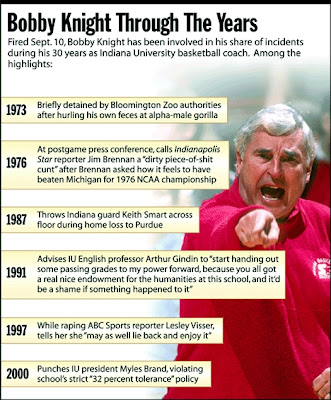
Let me close by resurrecting this “chart” from The Onion, from when Knight was fired by IU.
It was in the late summer of 1969. I had been out of college a few weeks, and had settled into my first job at WOOD AM-FM-TV in Grand Rapids, Michigan. It was a Sunday afternoon, and I was busy writing hourly five-minute radio newscasts and starting to work producing the 11:00 p.m. television newscast.
In those days there were no reporters and no photographers on weekend duty. The 11:00 p.m. (which might have been only 15 minutes long in those days), was delivered by an anchor who came in at 10:00 p.m. just for that purpose. For video it featured whatever national footage the network sent us. On the radio side the disc jockeys read the news.
There weren’t five people in the building (counting engineers) when all hell broke loose! The wire machine bells went off: a tornado warning was issued for our area.
I knew what to do. We all knew what to do. It had been drilled into us by News Director Dick Cheverton, after a debacle the year before. In 1968, major tornados had hit the area with no warning. An investigation had been held to find out why the word never went out. Who dropped the ball, the “Weather Bureau” (as we still called it: the official name was changed to the National Weather Service only in 1967) or the media? In the end, the NWS got the blame. But “Chev” was determined that in the future there never be even a hint that his station had failed the public, and he transformed the way we aired weather bulletins.
So I ducked into the little closet that served as an audio booth right inside the newsroom—not ten feet from my desk. In front of me I had a mic and a set of three lights and three switches. The first pair, white, signaled the disc jockey to introduce a weather bulletin when it was next convenient—after a song or after a commercial. That was for most weather watches. The yellow pair signaled the DJ to toss it to me now! And the red pair cut into all programming on radio and TV and put me on the air instantly.
I flipped the red switch and read the bulletin—a Tornado Warning—for both radio stations and television.
With a tornado warning—the NWS saying a funnel cloud had been sighted—our policy was to repeat the announcement every 7-10 minutes until the "all clear" was issued. That gave me a few minutes between sessions in the closet to start calling the staff in and to start calling local police agencies for reports before I had to air the latest bulletin.
It went that way for the next two hours while the staff hurried in: air the bulletin—make some calls—air the bulletin—make more calls.
Chev showed up and started to dispatch reporters and photographers to areas of reported sightings.
Finally, after two or three hours of non-stop activity, Chev came up to me. “You’ve done a great job. I’m going to have one of the anchors take over now, but I can’t let you go just yet. Take Tom (Chief Photographer Tom O’Rourke) and head north of here towards the latest funnel sightings." The newsroom was in a half-basement—just a few windows high on the walls. I knew it was still a sunny day out, but it was great to be out in the sun and to be moving. Tom and I packed the car and headed down the driveway.
And I saw a man mowing his lawn.
And a “Mister Softee” truck making its way up College Avenue.
And a bunch of kids playing baseball in a vacant lot.
And another man washing his car.
And I desperately wanted to lean out the car window and scream, DIDN’T YOU HEAR ME???
THERE’S A TORNADO WARNING!
TAKE COVER! TAKE COVER!
RUN FOR YOUR LIVES!
And I learned that my professors at Michigan State had been right: to communicate you have to have a sender and a receiver. You can put it in books and newspapers and on radio and TV—and these days on the internet: but if no one reads it or hears it or sees it the job of communicating is only half-done, which is the same as not being done at all.
Turns out that most of the twisters that day stayed aloft, never reaching the ground and never doing any damage. The one or two funnels that did reach ground cut through farm fields: no one hurt, no buildings destroyed.
I guess I was the one who felt left twisting in the wind that day. I have felt that way a lot over the years: Didn’t you hear? Didn’t you see? Why don’t you pay attention? This is important!
We talk about "making a difference," but when I see how “informed” our citizenry is, despite our best efforts, I wonder sometimes why we bother. Have you got any good answers?
What is the role of a journalist in modern society? Observer? Crusader? Advocate? Analyist? Teacher? Interpreter? Transcriber? Judge and Jury?
The second major newspaper in Detroit, the Detroit Evening News, began publication in 1873. It was the city’s dominant paper in 1917 when it commissioned architect Albert Kahn to design its new building at Lafayette and Fort Streets. Ninety years later that building and the paper it houses are still there.
The News also has the distinction of signing on the nation’s first newspaper-owned radio station 8MK, on August 20, 1922. That station later became WWJ. WWJ-AM gave birth to WWJ-TV. I worked there in the early 70s, and again in the late 70s when it had been sold to the Washington Post and rechristened WDIV-TV.
Our newsroom was headquartered on the third floor of the huge old WWJ radio building, across the street from the Evening News. From a third-floor stairwell at the back of the newsroom you could get a clear view of the higher floors of the News building, and the inscriptions carved into the parapet on top. Each panel lists three attributes of the ideal newspaper.
Forget Charles Foster Kane and his “Declaration of Principles” in Citizen Kane. A 1922 book says, “The inscriptions on the parapet, of which Prof. F.N. Scott, of the University of Michigan, is the author…express the ideal of the newspaper housed therein and the goal towards which it strives. "
Mirror of the Public Mind… Interpreter of the Public Intent… Troubler of the Public Conscience Reflector of Every Human Interest… Friend of Every Righteous Cause… Encourager of Every Generous Act
Bearer of Intelligence… Dispeller of Ignorance and Prejudice… A Light Shining Into All Dark Places
Promoter of Civic Welfare and Civic Pride… Bond of Civic Unity… Protector of Civic Rights
Scourge of Evil Doers… Exposer of Secret Inequities… Unrelenting Foe of Privilege and Corruption
Voice of the Lonely and Oppressed… Advocate of Friendliness… Righter of Public and Private Wrongs
Chronicler of Facts… Sifter of Rumors and Opinions… Minister of the Truth that Makes Men Free
Reporter of the New… Remembrancer of the Old and Tried… Herald of What is to Come
Defender of Civil Liberty… Strengthener of Loyalty… Pillar and Stay of Democratic Government Upholder of the Home… Nourisher of the Community Spirit… Art, Letters and Science of the Common People
"Scourge of Evil Doers." I like that. How about "A Light Shining Into All dark Places?" I like that one, too. If that has a familiar ring to it, it's because the News was founded by James E. Scripps, the half-brother of Edward W. Scripps. The Scripps-Howard motto, carried forward to the E. W. Scripps Company and its newspaper, TV and cable empire remains, "Give Light and the People Will Find Their Own Way."
David Brinkley used to say that it's easy to mistake journalists for liberals, because in their heart of hearts both have the same dream: to ride in on a white horse and save the world.
Tell me. Is Bill O'Reilly the "Dispeller of Ignorance and Prejudice?" Is Rush Limbaugh an "Advocate of Friendliness?"
I've written here before about Hurricane Andrew. Not much more can be said. But pictures are worth a thousand words, and I just came across these on YouTube.
This video does need some setup, though. This is WCIX, Channel 6, the CBS O-and-O. These days it's still CBS-owned, but now it's WFOR on Channel 4.
Our tower toppled during the storm, so we were up only on a low-power "translator." The good news is that most cable companies could pick up the low-power station. The bad news is that no one had cable. Hell, no one had electricity! As far as it goes, this was something of an exercise in futility: the hardest-hit people, the folks who needed us most, had no way to watch our news!
The anchor team is Barbara Sloan and the inimitable John Hambrick. I'll be honest: Hambrick was "high maintenance." I drank a gallon (see previous posts) with John many times. But when the chips were down not many anchors could deliver like John Hambrick. Here he is, at his best.
This newscast is probably from August 25th, 1992 (the day after) or the 26th (two days after).
One thing I'm proudest of is that I encouraged "first person" reporting. I had our reporters tell their storm stories. Dave Game is on this segment. Dave was named "Best Reporter in Florida" by the AP for work like this. His description of what happened to his wife and his home during Andrew is story-telling at its best: truth telling. By the way, if he looks a little disheveled, it's not just because he'd been out traipsing around in the "war zone." It was 95 degrees in the newsroom. You see, our emergency generator didn't supply full power to the entire station--only selected essential areas. The newsroom got electrical outlets--but no air conditioning, and at this point the hurricane shutters were still on. Somewhere in there I took a crowbar and broke out some windows to get fresh air. Imagine our staff of about 75, plus reporters and photographers and editors from all around the country, with no showers, and dragging water from the lagoon out back to flush the toilets. Whew!
Another thing I'm proud of is that we quickly moved past the "Ain't That A Shame" stories to more meaningful information. Eventually we dedicated a whole program (Neighbors Helping Neighbors) to matching people who had with people who needed. Oh, we still did the obligatory "The Perez Family is homeless" stories, but we tried to put meaningful information on the air. That program and that effort went on for months.
Sorry: this "short" introduction really rambled. But the video tells the tale.
This has nothing to do with TV news. It's just me, amazed to be so damned old!
Went to the pharmacy the other day to pick up some prescriptions. Behind the counter was a little old lady--wrinkled, white-haired, slightly stooped--obviously having trouble figuring out how to run the cash register. I patiently awaited my turn, feeling a little annoyed at her incompetence, but also kind of sorry for an elderly woman obviously in way over her head.
When it was finally my turn she asked my name and birth date. I told her both, and she said, "You and I were both born in the same year!"
Now, I just celebrated a birthday. I'm 61. That means that unless she had her birthday early in January I'm older than she is!
Makes me wonder if on the other side of the counter they're saying, "Here comes that old guy again."
My father just turned 89 (God bless him). I sent him a card, On the front it said, "Inside every old man is a young man."
Opened up it read, "Wondering what the hell happened."
This one borders on the politically incorrect: but dammit, it’s funny.
I’ve mentioned my time as Executive Producer for WISH-TV in Indianapolis here before; and the station’s controversial, colorful, way, way bigger-than-life sports director Chet Coppock.
Did I say bigger than life? How does 6’8” sound? Did I say colorful? The guy at one time was the track announcer for the roller derby! I’ve seen pictures of him in a white floor-length fur coat sporting a white fur gangster’s hat.
Did I say controversial? Chet would say just about anything to get a rise out of people, to get the juices flowing, to spur conversation. Example? Longtime WISH-TV anchor Mike Ahern (now retired) was a Notre Dame grad. Chet would rag on Notre Dame every Friday night during the college football season just to see if he could make mild-mannered Mike take the bait.
Controversial? One night he asked if I’d like to go down to Market Square Arena with him for a quick appearance between newscasts. He was giving away a new Cadillac at halftime of a Pacers game. Just walking into the place with Chet was an experience. He moved steadily forward like a boat cutting through water, leaving a wake behind. In his case the wake was people parting, letting him pass, standing, staring, whispering “That’s Chet Coppock.” “There goes Chet Coppock.” “Isn’t that Chet Coppock?” I’d been around famous people before—but at that place at that time Chet received a kind of jaw-dropped-in-awe reception I had never seen before.
Come halftime Chet was introduced—to the loudest chorus of boos you ever heard. He grinned, waved, and walked (OK, strutted) to center court, drew the winning name, and with both hands waving over his head made his way to the bench. He was almost beside himself with joy.
“Uh, but, Chet,” I said, “uh, you DID notice that 18,000 people were ALL booing?” And he flashed me that klieg-light smile and said, “Yeah, and they ALL WATCH! How great is that?”
In an Indianapolis Star poll Chet was named the area’s most-liked sportscaster, and the most disliked. He still brags about that!
My favorite story, though, is from behind the scenes. WISH-TV was owned by Corinthian Broadcasting—a division of Dow Jones—and the station was run by a man named Bob McConnell, son of the founder and owner of the station, and the man who sold it to Corinthian. Bob stayed on as the hired GM.
In 1976 Chet was involved in negotiations for a new contract. There was a lot of back-and-forth. How do I know? I heard the play-by-play. Chet delivered not only the PBP but also the color commentary on his own contract negotiations!.
You see, the WISH-TV newsroom had its own PA system: newsroom only, not heard anywhere else in the building. Chet got into the habit of coming downstairs after a bargaining session, picking up the PA mic, and giving us a running commentary—as if it were a prize fight.
And here’s where I’m going to get into hot water. Bob McConnell spoke with a pronounced lisp, and Chet could imitate him with dead-on accuracy.
So one day we heard:
“ROUND FOUR!
"McCONNELL THROWS HEAVY LEATHER: Chet, no one in thith market ith making the kind of money you’re athking.
“COPPOCK COUNTERS WITH A SERIES OF STINGING JABS: Mr. McConnell, you know my value. You hear it in word-of-mouth on the street, and you see it in every rating book. Since I arrived here every book shows that every newscast on which I appear has experienced constant and dramatic audience growth. I wouldn’t be silly enough to claim full credit, but I do want to be rewarded for my part in our success. “BUT McCONNELL COMES BACK SWINGING:Lithen, Chet, all of uth think you’re doing a nithe job. But my father didn’t thine this thtation on the air twenty-thevenyearth ago for me to hand it over to thomethporthcaster on a thilver platter.
“AND THE BELL RINGS ENDING ROUND FOUR!”
And the crowd went wild!
Honestly, now: we were all in hysterics, but I don’t think we were laughing at Bob McConnell’s speech impediment. We were just amazed at Chet Coppock’s audacity, his chutzpah, his perfect mixture of self-confidence and impudence, his bad-boy persona, his gift for mimicry. I’m still laughing, 32 years later.
It was Sunday, January 12, 1975. The Pittsburgh Steelers were in the Super Bowl for the first time: Super Bowl IX (as in “Nine”). No, my young readers, 33 years ago players did not wear leather helmets. And no, television news coverage wasn’t in black-and-white, it was in color (although at KDKA-TV, the kick-butt #1 station in Pittsburgh, our news stories were shot on film, not tape). And covering the activities in New Orleans for the week leading up to the big game meant shipping film back to the station. No satellites, no same-day coverage.
Good thing KDKA had “The Mouth of the South,” Bill Currie, as our sports director. He had a nose for…uh…detail! He was there when the motor homes carrying “Gerella’s Guerillas,” the fan club for kicker Roy Gerella, pulled into Tulane Stadium. Currie was rambling on about the arduous trip down from Pittsburgh, the non-stop hours on the road, the testing of man and machine when the RV convoy creaked to a stop. The doors burst open, a bugle charge was sounded, and the first five guys to pile out were balancing cases of beer on top of their heads.
Currie turned, paused a perfect beat-and-a-half, and said, “Obviously involved in some sort of religious observance.”
Super Bowl Sunday
Remember, in those days the game started at 4:00 or 4:30. There was no nine-hour pre-game show with 1,000 Elvis impersonators riding wildebeests around the stadium side-saddle with the reins in their mouths while shooting live wombats into the crowd from T-shirt cannons while scantily-clad cheerleaders passed up and down the aisles handing out complimentary packets of Purina Wombat Chow. Yeah, in those days the Super Bowl was already wrapped tightly in the American flag (you know; if I have ten flags on my lawn and you only have five, I'm twice as good an Amur'can as youse): but for the most part it was a football game!
Problem was, the game was on NBC, and at KDKA (CBS) we were scheduled to air a newscast at 6:00.
But what are you gonna do? The game was far from over and far from decided when 6PM rolled around. On NBC, it was 2-0 Steelers at the half after Minnesota Vikings QB Fran Tarkenton fell on a fumble in the end zone and was covered by Dwight White for a safety. I guess an ought-ought tie would have been closer, but certainly not as dramatic!
Our newscast open rolled, anchor Dennis Holly was cued, and said “Good evening, I’m Dennis Holly. What…are…YOU…doing…HERE??????”
After he tossed to the first story, I leaned into the IFB and said, “Holly, if station management is watching you’re in big trouble.”
Of course, they weren't (watching) and he wasn't (in trouble). No one in Pittsburgh was watching us that night. We were hardly watching. In the control room and down on the studio floor, the entire KDKA production staff was watching the game out of the corners of our eyes.
In the end the Steelers beat the Minnesota Vikings 16 to 6 for their first Super Bowl victory (with many more to come). Franco Harris ran for 158 yards on 38 carries and was named MVP. Other Steeler names you might remember: Terry Bradshaw, “Mean” Joe Greene, linebackers Jack Ham and Jack Lambert, receiver Lynn Swann and—of course—coach Chuck Noll. Ten members of that team made it into the Pro Football Hall of Fame. Any arguments? I didn't think so.
I left KDKA not long after, and lost track of Dennis Holly. Even a “Google” search couldn’t tell me where he is now and what he’s doing. I was able to track him to KXAS in Dallas in the eighties…but the trail goes cold after that. Anyone know where Dennis Holly is today?
It was December 31st in either 1982 or 1983. Best guess, it was '82--25 years ago tonight. ABC—as always—was carrying the “ball drop” in Time’s Square to welcome in the New Year. At WABC we decided to cover the event—and cover the coverage. We decided that at 11:00 p.m. we’d go live from Time’s Square, from the same venue as Dick Clark & Co.; we’d see the crowd, the festivities, and do a “behind the scenes” feature on the broadcast scheduled to start when Eyewitness News ended. The hardest part was getting all the clearances and insurance waivers signed. That done, I decided I’d tag along. I didn’t know if there was anything I could do to help, but I knew my presence couldn’t hurt, and I figured it would be a memorable experience.
These days ABC broadcasts from its own studio overlooking Time’s Square. But back then, Dick Clark and his crew were huddled on a building ledge about twenty stories above the crowd. Well, maybe it wasn’t a ledge—no one was in danger of falling. But I don’t think you could call it a balcony. It was a parapet, a 15-foot-wide piece of concrete outside an upper floor of the Minskoff Theater, with a sturdy metal railing to keep people from toppling off onto Broadway.
So Dick Clark and his 30-or-so staffers, and WABC Reporter Doug Johnson and five or six of us made our way up to our perch. It wasn’t easy: to get there the equipment had to be hauled through the innards of the theater and through the lighting booth (past the spotlights and lighting boards) to the one door that led outside.
30-40 people humped crates of equipment up the stairs, through a doorway, and onto a narrow perch overlooking—a sea of screaming boo-hoos: jostling, necking, yelling, drinking, peeing, groping, inhaling, injecting, puking, mugging and staggering. And to try to keep them under control, THE CAVALRY! That’s right, a sea of mounted police.
Up where we were, there was no crime, no drunken rowdiness. What we had was freezing wind. Gale force winds swept through the canyons of Manhattan and quickly had us all stamping our feet to ward off frostbite.
And here’s something you don’t see on TV (the cameras carefully avoid showing it). The screaming boo-hoos are treated like cattle and herded into pens. For security purposes (and this was almost 20 years before 9/11) Time’s Square was sectioned off by barricades. Instead of one solid sea of people, the crowd was stuffed behind those barricades, leaving pathways down the major streets for police and ambulance traffic. The cameras show the huge crowds from up close. If they pulled back just a bit you’d see the cattle pens, and cops playing cowboy, riding herd.
And that’s pretty much that. We did our live shot, dragged our equipment back down to the street, then trudged back up to watch Dick Clark announce the ball drop at midnight. Nice. But not one of the “Dozen things You Have to Do Before You Die.”
At 12:01 a.m. I was out of there. In those days I lived in an apartment at 56th & Broadway—eleven blocks up Broadway. I went the back way. I went west to Eighth Avenue, up to 56h, and over. I had the streets to myself. No one tried to pick my pocket, no hooker propositioned me, no drunk puked on my shoes, I heard no gunfire. I got home at 12:15, watched a bit of the coverage, and was in bed by 12:30.
I spent New Year’s Eve in Times Square and came back alive!
Whatever you’ve got planned for tonight—have a great and a safe time. Stay out of Time's Square!
And the best of everything in the New Year. _________________________________________________ A New Year's Day postscript. I stayed up until midnight last night to watch Dick Clark in Time's Square. That's unusual for me. I'm not much of a party-goer or a party guest, and I haven't had a drink in over ten years.
Dick Clark, in some ways, was hard to watch. The stroke he had three years ago has left him with slurred speech and a slight tremble., On the othe hand, you have to remember that he's 78 years old now! Stroke or not, there are plenty of people a lot younger than Dick Clark in a lot worse shape.
Youngsters won't remember--but for the longest time Dick Clark was seen as a Picture of Dorian Gray type: ageless. On that rooftop a quarter-century ago he looked to be in his late thirties or early forties. Seeing him now as an old man is a grim reminder for us baby-boomers that nobody gets out of life alive. But he's also an example of fighting the good fight.
There's a New Year's message for all of us: keep up the fight!
Although it came out several years ago, I just now saw (on cable), the film Mrs. Harris. It’s the story of Jean Harris who killed her lover, diet doctor Herman Tarnower, back in 1980. Annette Bening played Mrs. Harris, Sir Ben Kingsley played Dr. Tarnower.
Here’s the short-hand version. She was the principal of an exclusive girls’ school in Virginia; he was a womanizing cad who gained fame by inventing something called “The Scarsdale Diet,” and writing a book about it which sold millions of copies, turned him into a household name, and made him wildly rich. During their 15-year relationship he played her for a fool and ran around with countless women. Finally, on the night of March 10, 1980, she went to his home to confront him. Next thing you know he’s dead, shot four times, and she’s under arrest.
But this isn’t about him—or about her—or about them. It’s about Milton Lewis. If you’re a New Yorker (pronounced Noo-Yawker) you already know the name. Milton was a superstar reporter for WABC-TV in New York from the mid-sixties through the mid-eighties: an old newspaperman who started during the depression as a copyboy with the New York World and later at the New York Herald Tribune where he worked his way up to reporter and spent 34 years. He was a character out of Damon Runyon. He was a Noo Yawker. He was about 5’4”, rumpled, and cranky. And he was a helluva reporter.
He was the one broadcast reporter in town best plugged into the world of organized crime, and proud to be a burr under the saddle of the mob bosses. (I remember one night, on set, he looked into the camera and said, “Today in court Carmine ‘The Snake’ Persico…who doesn’t like it much when I refer to him as ‘The Snake’”…).
Since I was a newcomer to New York and to Eyewitness News he was predictably impatient with me. I’m not sure he ever called me by name. He’d call in to the desk on the two-way radio and ask to speak to “The incumbent assignment manager," his voice dripping with sarcasm.
He knew and enjoyed his role as our brash, “Listen-Sister-Get-Me-Rewrite” old newspaperman, our throwback to the Ben Hecht Front Page days of newspapering. But he also embraced the power and the visibility TV gave him, and knew how to play his new role to the hilt.
His catch-phrase for an exclusive story was, “Now listen to this.” Then he’d drop his bombshell. His job was to sit on the set next to anchor Roger Grimsby every night and throw Grimsby a tag line he could react to—if he so chose. And it really made no never-mind to Milton Lewis. He was there to toss the softball. Grimsby could hit a homerun, swing and miss, or leave the bat on his shoulder—it was all the same to Milton.
Back to the Harris case, one of Milton’s finest hours and one of his scoops. I wasn’t at Eyewitness News at the time of the shooting, but I was sure there for the trial. I saw to it that every day Milton and one of our best crews went to the courthouse along with a live truck and courtroom artist Marilyn Church.
I won’t take time here to rave about Marilyn—the country’s preeminent courtroom sketch artist. If you go to the internet you can spend thousands on some of her original artwork: “Son of Sam” David Berkowitz; John Lennon’s killer Mark David Chapman; mob boss John Gotti; “subway vigilante” Bernard Goetz.The picture above is one of her Harris trial sketches: a series of seven available for $18,500.
Or you might just want to buy her book: Art of Justice: An Eyewitness View of Thirty Infamous Trials, written with long-time reporter Lou Young.
Anyway. As the trial got underway, the big question was would Mrs. Harris testify in her own behalf? Of course, it was Milton Lewis who provided the definitive answer in an exclusive report, sitting on-set next to Grimsby:
"Now…listen…to…this!
I’ve learned that Mrs. Harris WILL take the stand. She’s going to testify that she didn’t go to the Tarnower home to commit MURDER; she went there to commit SUICIDE! And while she and the good doctor struggled over the gun…
…it ACCIDENTALLY went off…
…hitting him FOUR TIMES.
Roger?"
________________________________________________ Two updates. New York Governor Mario Cuomo commuted Jean Harris’ sentence after 12 years in prison. She’s 84 now.
I did a “Google” search on Milton Lewis and came up with a fairly recent article written by one of his grandchildren that says he’s 94 now, living in the Jewish Home on Silver Ave in San Francisco, and still feisty.
I can imagine him haranguing the staff: "Now Listen to THIS!"
I’d like to think that I’m still learning, but one lesson came 33 years ago this month.
I was working for WJBK-TV, at that time the CBS affiliate in Detroit. Later Channel 2 became a Fox affiliate and O-and-O (although an ownership change is pending as I write this). Back then ‘JBK was the key station in the Storer Broadcasting empire. Back then there was a Storer and it was an empire.
It was Christmas, ’74. Many of my faithful (and fretful) readers weren’t even born yet, so a history lesson is in order.
Greatly simplified, the American economy had been sent reeling by something called the “Arab Oil Embargo.” For three weeks in October, 1973, Israel was at war with a coalition of Arab states led by Egypt and Syria: the “Yom Kippur War,” so-called because it began with an attack on Israel on that Jewish Holiday. Despite early setbacks, Israel had gained the upper hand when the United Nations brokered a cease-fire in late October. In the middle of the war the Organization of Petroleum Exporting countries announced that it was cutting crude oil shipments to the west to punish Israel’s supporters. The U.S. was, of course, the primary target of the Arab Oil Embargo.
These numbers sound silly today, but back then they sent shock waves through the world economy: oil prices quickly jumped almost 20% to $3.65 a barrel. In the U.S. the price of a gallon of gas—which had been around 35 cents—rose sharply. Gas stations were running out; lines at the pumps stretched for blocks. Each newscast brought word of fistfights—even shootings—as angry motorists practiced vigilante justice on line jumpers. To try to ease the lines, stations started selling to drivers with odd-numbered license plates only on odd-numbered days. Back then the normal speed limit on the interstates was 70 M.P.H. Proposals were quickly enacted to cut it to 55 to save gas.
This country started on a path to recession and high inflation that persisted into the early 80s, and high oil prices that stayed with us until 1986.
Back in those days the words “Detroit” and “autos” were interchangeable. And the prevailing wisdom went something like this: If Detroit sneezes the American economy catches a cold. Americans were afraid. They had been driving big gas-guzzling behemoths for years—it was The American Way, dammit! You can’t have a car without tail fins and whitewall tires, can you?
I could. I did. I was driving a Volkswagen Beetle with a 12-gallon gas tank. Now, don’t ask me to do the adjusted-for-inflation math. All I know is that a fill-up on my ’69 Beetle back then cost less than four bucks! I wasn’t alone. All of a sudden American drivers were looking at German cars—and even those new, tinny, rattle-trap Japanese cars—and wondering if they held the answer. I had a friend who bought a Saab, back before they had sex appeal: a three-cylinder Saab that sounded as if Briggs and Stratton were having a fistfight under the hood. Was this the next step for Detroit?
That’s what Ike Pappas wondered when he came to The Motor City in December, ’74. The embargo was over but the rising gas prices, the inflation and the jitters remained. Ike was a solid, seasoned correspondent for CBS News. He talked the brass into sending him to Detroit for a report to air Christmas week. The premise: Let’s examine Christmas spending and consumer attitudes in the one American city most tied to oil.
He must have done a good selling job. Those were the days of the three-person film crew: cameraman, soundman, lighting man (Sorry, not “persons.” No women in those days. Not my doing. Don't blame me.)
Ike Pappas came to town with two three-man film crews, a producer, and his own film editor out of New York. CBS shipped in a Steenbeck eight-plate film editing console (about the size of a meat freezer in your local supermarket). The union contract stipulated individual rooms (no doubling up), so that was nine top-of-the-line hotel (not motel) rooms for a week. Meals for all. Four cars.
Back in those days, with all the equipment (tripods, lights, batteries, mics, cables) everyone had his hands full, so frequently each packed only one small overnight bag. The crew bought the clothing they needed on location, and shipped the dirty laundry back home. CBS paid for it all.
But this was a big one. Ike and crew had been promised seven minutes on The CBS Evening News with Walter Cronkite. Christmas week would be slow, there’d be room for an in-depth report, and everyone seemed to want to do this right.
And Ike and company busted their butts! They were all over town morning to night, talking to labor leaders, auto bigwigs (Henry Ford II himself), production line workers, shopkeepers, average Joes.
At WJBK, where we knew Michigan like the back of our hand (come to think of it, Michigan is shaped like a hand stuck in a mitten), even we were dying to see what Ike had to say.
Ike was given a desk in the back of the newsroom, next to mine, so we had several interesting conversations. All I remember is thinking what a decent, intelligent, straightforward professional he was.
The day before his piece was to air I walked to my desk and noticed Ike hunched over the phone. But something was wrong! The muscles in his neck were knotted. The back of his neck was beet-red. He started shaking. I’m thinking, “Am I watching a man have a heart attack?” I didn’t know what to do.
Just as I was about to step forward he hung up the phone, let out a huge sigh, and turned to face me.
“Ike, are you OK?”
“Kid, don’t ever take a job with a network.” (I think he actually called me “kid.”) “I was just talking to a junior producer at Cronkite. I told him about the mood of Detroit. He said, ‘That’s not the mood in Detroit. According to this morning’s New York Times thisis the mood in Detroit.’ And he told me I have a minute-forty-five tomorrow night.”
Don’t know that I’ve ever heard a man more disheartened.
In the years since I never got the chance to take his advice: never got an offer from a network. I know several people who are happy—or say they are—working as network correspondents. It’s not for everyone. And in this age of multiple delivery systems the pressure to file and file and re-file your pieces is tremendous.
Ike Pappas should have taken his own advice. He later got screwed by CBS. He was never movie star-handsome, but he knew how to work a beat and tell a story, and he rose to become Pentagon correspondent. But under President Van Gordon Sauter, CBS News divided itself up into "yesterday" people and "today" people. Guess which list Pappas was on? In the end he was tucked away covering the "labor beat." Guess how much face time he got on the CBS Evening News with Dan Rather. He knew his stuff, and he delivered solid material, but there wasn’t much room for reporting that didn’t come wrapped up in a handsome package. Some years later Ike Pappas got caught up in one of those (seemingly interminable) rounds of CBS layoffs. Funny: the good-looking correspondents stayed, Ike Pappas was bought out of his contract. He found himself down-sized.
Here's another horrible irony. He was in New York to accept an award from the Greek Orthodox Church--former President Jimmy Carter was on hand--when he got word that he no longer had a job. The network he loved and served didn't love him back.
The Detroit auto industry has been down-sized over the years, too. Ike saw it coming in 1974. He told us so in a tightly-produced report that ran 1:45. Excellent reporting. It left me wanting more. That was 33 years ago this week.
I said in today's earlier post that at least no TV tower had collapsed in the ice storm that swept through overnight. . I spoke way too soon. Apparently one of WNEP's two Penobscot towers toppled onto the transmitter building. I didn't notice this morning because WNEP uses microwave and fiber optics to deliver its signal to many cable companies, my supplier included. I was watching Channel 16 on a cable feed.
The collapse also damaged WYOU's power lines. CBS programming on my local cable TV is being routed in from KYW-TV in Philadelphia. A bit surprising to look up at 6:00 p.m. tonight and see the Philly newscast with Philly weather and sports. And Philly commercials!
WBRE has been on and off--but I saw the Channel 28 newscast at 6:00 on my cable. Truth is, I'm not sure anyone is actually on-air over-the-air right now, and information on a wicked weather Sunday is hard to come by.
This isn't a hard news, breaking news site--that's not my purpose--but it will be interesting seeing how this shakes out in the weeks ahead.
As for me: been there, done that. I was at WCIX (now WFOR) in Miami when our tower collapsed at the height of Hurricane Andrew in '92. At 1,860+ feet it was the tallest man-made structure in Florida.
Was.
If you're in the business, you know that towers are designed to crumple straight down into one heap. "Andrew" pushed that big stick straight over. It wound up stretched across 1,860 feet of mango groves down near Homestead. It also fell over the transmitter building. Two engineers were inside. They thought they heard something--but with the storm throwing mangoes at the side of the building at 120 miles-an-hour, they didn't want to stick their heads out to look.
They were OK. But I remember the GM, Allen Shaklan, sitting in my office when news of the collapse came. He leaned forward in his chair and put his head in his hands.
For about sixty seconds.
Then he--and we--pressed ahead.
I know the local broadcasters will do the same. Some engineweers are in for some sleepless nights, but it will work itself out.
It’s Sunday morning, and the wind is howling by my window. The nor’easter predicted for this weekend is here—sort of.
We didn’t get the feet of snow that was mentioned a few days ago as a possibility—but I’m still calling it a big victory for the area meteorologists. I think we got lucky by about a hundred miles. North of here it’s snowing. Overnight, here, we had freezing rain. I opened my sliding glass door at about 2:00 a.m. and the sleet sounded like BBs bouncing off the icy pavement. We’ve got a break right now—then the snow hits. I know there’s a difference between snow and freezing rain—but how big a difference, really? The bottom line is that the meteorologists said Sunday would be a horrible travel day. They were right.
People raided the stores Friday for their French Toast makin’s. It still surprises me that some people think any forecast of snow means they’re going to be snowed in until spring. They must have seen Seven Brides for Seven Brothers on cable once too often.
Some other thoughts.
As I write this several local TV stations are off the air: most notably WYOU (CBS) and WBRE (NBC). All the local stations have their towers on Penobscot Mountain, and the power is out up there. I’m not sure if WNEP (ABC) is working on its own generator power this morning, but they’re on the air. During the morning news, anchor Andy Palumbo mentioned that the power outage kept WNEP from receiving microwave signals. It’ll be interesting seeing when the other stations get back on. This is one of those mornings when you’re dying for a local forecast—and only WNEP was able to deliver.
Many years ago WBRE lost its tower when it collapsed during an ice storm. It doesn’t sound like this will come to that.
When I posted earlier this week about the pending nor’easter, I didn’t bother to mention the heavy snow predicted for Thursday. So here’s a big “attaboy/attagirl” to the meteorologists. They said the storm would start at 7:00 a.m. over most of the region—and taper off in the afternoon. They said to expect 5-6” of snow—more in what we call the Northern Tier of counties and the Poconos.
They were dead on! The snow started when they said—came down as fast as they said—accumulated as much as they said—and died down when they said.
The important thing to note is that virtually every school district in the area paid attention and canceled classes for the day; in some cases the night before. Thank God! It was hairy enough there for awhile it would have made getting home from school Thursday afternoon a nightmare.
It drives me crazy when school districts keep kids for a half-day, dismissing them early when snow hits mid-day. Why would they do that? Easy. They get state credit for a class day even if the kids spend only a couple of hours in class. It's dollars, even if it doesn't make much sense.
Another note about school closings. Whether I had a hand in developing the computerized closing system or not, it has changed the way school superintendents view snow days.
Now, when I was a boy (I know, cover your ears if you don’t want to hear a “remember when” story), I don’t think classes in my suburban Cleveland school district were canceled more than five or six times during my entire K-12 career. And delays? Classes were never delayed.
Were we tougher back then—descended from heartier stock? Possibly, but I don’t think that’s the reason for the change.
First, I think the computerized closings on TV made it easier for the superintendents to cancel or delay classes. Used to be, they’d have to get up at 5:00 a.m., decide what to do, then start calling five, or six, or a dozen radio stations. Then came TV listings—and it took only two or three calls. Today it can all be done almost automatically from a computer. “Dr. Jones,” the superintendent, rolls out of bed, checks out the window, goes to his PC, and ten minutes later he can be back in bed, dreaming of high standardized test scores.
Second reason: if kids aren’t weaker, maybe it’s that lawyers are stronger. “Dr. Jones” is thinking, “You know, Milt isn’t that great a driver. God forbid the bus slides sideways three feet and clips a mailbox. I’ll have 37 lawyers in the office claiming whiplash for 37 kids—when there were only 25 on the bus. We’ll get sued for an amount of money equal to the GNP of some emerging countries. Jeez, we can’t even play dodge ball in the gym without someone filing a personal injury lawsuit! I should take chances?” And it’s back to the land of nod.
It comes down to this: school superintendents are a bit gun-shy these days. Hell, they have guns pointed at them!
So I suggest we honor the real heroes of the last few days. Can I declare this “Hug a Meteorologist” week?
There’s talk of a nor’easter this weekend. They (meteorologists, that is) say that if a low pressure area along the East Coast does one thing, and the winds in the left forward quadrant rotate onto land from the northeast, and the warm front, the occluded front and the cold front do their things, and the Arctic air mass does something else altogether—well, we could be talking feet of snow this weekend, not inches! It’s the converging air masses, I tell ya! Something to do with “vorticity” they say (those same pesky meteorologists!).
And you know what that means.
FRENCH TOAST WEATHER!
I don’t know about your area, but here in northeastern Pennsylvania even the slightest threat of snow sends people scurrying to the store. They'll head out later this week to strip the shelves of bread, milk and eggs. What could they be doing but making French toast? (Holy crap, I don’t want to even think of where the 20 rolls of toilet paper they’re buying fit into the recipe!)
Everyone is going to head to the store in his or her humongous S.U.V.—the one that’s slightly bigger than a Conestoga wagon—then park it in the garage for four or five days. Around here everyone owns an S.U.V., but no one actually uses theirs to go off-road or to drive in snow. They’re for show, not go. Something about penis size, if you ask me. Are Humvee dealers subsidized by OPEC?
(By the way—different topic altogether: why have your fog lights on in the daytime? At night they might help you see the road, but in daylight it’s already plenty bright; they can’t cut through the fog. They’re useless. If it’s foggy and you want to be seen by other drivers, won’t your regular headlights do just fine? Why are you driving around on dry pavement on a cloudy day in a land-yacht the size of a Bradley Fighting Vehicle with a 747’s landing lights on?)
Sorry. Lost the thread there a bit. Back to the weather.
The next few days will be tough ones for meteorologists. God forbid—if the storm does come—that they’ve predicted a half-inch more snow than we get: they’ll be accused of sensationalizing the weather, of panicking the populace. If we get a half-inch less, they’ll be branded as inaccurate and criticized without mercy. Newspapers, especially, take gleeful pleasure in skewering TV meteorologists.
Truth is, even given the tremendous technological advances in forecasting over the last twenty-or-so years, predicting the weather is still an inexact science. Think about it. If NASA, with its billion-trillion-gazillion dollar budget can’t figure out if it’s going to rain two days out from a shuttle launch at the Cape, how can we honestly expect a TV meteorologist to get a ten-day forecast dead-on for every hill and vale in a 22-county viewing area?
I’ve long said that those “Ten Day Forecasts” are nothing but window dressing. Seven days? Silly. A great meteorologist working with the latest equipment and access to the best data has a good chance of getting it right three days out—but there are just too many variables standing in the way of 100% accuracy.
I got a letter many years ago from an arrogant ass (a man not unlike myself, I guess!), who said, basically—In my line of work, commercial refrigeration, I wouldn’t last long if I were only as good as your so-called forecasters. He actually might have underlined "so-called."
My reply went something like this:
“Then you ought to be calling up supermarkets each night and saying, ‘I know with 100% certainty that the compressor on meat case #3 is going to fail overnight. Why don’t you move the meat now, and I’ll bring a new compressor over in the morning.’ Seems to me, Mr. Commercial Refrigeration Guy, that more variables go into weather patterns than there are in an electric motor.”
I’m a huge Charles Osgood fan. His poem, Broadcast News, fits here perfectly.
Remembered (I hope accurately) and reprinted without any permission whatsoever. So sue me.
Powerful are those who choose The items that make up the news. And yet in spite of all that power It’s much like singing in the shower.
For it is clear from card and letter That you all think you could do it better!
What kind of syrup do you like with your French toast?
 Elden was one of the first to use a big-screen TV on-set as an over-the-shoulder device for rolling film and showing slides. He'd have the director pull "still frames" from film for use in the monitor. One night he told the director he needed something to illustrate a bomb for a Middle-East story. The director made his choice. And that night the anchor (J. Kristopher, maybe?) went on the air with a still of Boris Badonov from Rocky and Bullwinkle. Not this shot, but a cartoon out-take of Boris holding a bowling-ball shaped bomb with a burning fuse!
 Anyway, the story goes that on one of the first nights out back a huge rain storm kicked up just as the meteorologist (Paul Douglas, if I remember the tale correctly) was wrapping up his forecast. The winds were so strong that they turned Douglas' umbrella inside out--RIGHT ON THE AIR! After the show the floor director (the late Sid Harris, according to legend) went to Elden and said, "Why don’t you give me $30 and I'll go out and buy a terrific umbrella so that never happens again." And Elden is said to have replied, "Here's $30, go out and buy ten $3 umbrellas so it ALWAYS happens." I don’t know for sure. I wasn’t there. But it certainly sounds like Elden Hale.